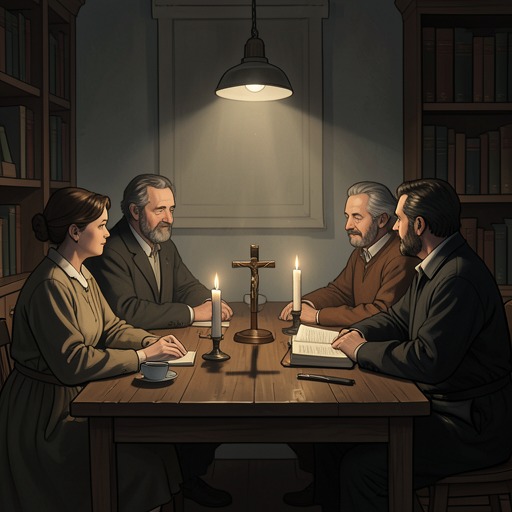
Father Gregory
Angela's AshesFather Gregory is a Franciscan priest who meets Frank McCourt at a moment when bereavement, hunger, shame, and religious fear have become inseparable. By listening without demanding that Frank first make sense of his troubles, he gives him room to speak; by granting absolution and affirming that Theresa Carmody is in heaven, he offers a compassionate answer to the fear that has overwhelmed him.
Identity and Introduction
Father Gregory appears in a church as Frank, newly sixteen, kneels in distress and finds that prayer to Saint Francis has not stopped his tears. The narration marks the priest’s arrival first through his brown robe and the black rosary beads, and then through his introduction: he is Father Gregory. His invitation is gentle and conditional: Frank may tell him what is troubling him only if he wants to. That permission matters in a scene otherwise shaped by Frank’s fear of condemnation and by earlier encounters with adults and religious authorities who have shut doors in his face.
Frank’s Confession
Frank tells Father Gregory that he is sixteen and explains the burdens he has brought to prayer. He speaks of his dead siblings Margaret, Oliver, and Eugene; of his father’s drinking and failure to provide money; of Theresa and the green sofa; and of the sins he associates with Carrigogunnell. His account also reaches beyond private grief to the children killed in concentration camps, his rejection by the Christian Brothers, the refusal to let him serve as an altar boy, his shame about his eyesight, and his distress over having struck his mother. The list joins losses, disappointments, guilt, and poverty: Frank is not asking about a single mistake so much as trying to give a name to the whole weight of his life.
Father Gregory does not interrupt that account with a judgment. He offers Frank the option of sitting quietly and praying, and then guides him through the formal steps of confession: he tells him to kneel, gives him absolution, and assigns three Hail Marys, three Our Fathers, and three Glory Bes. The priest’s pastoral response combines religious procedure with direct reassurance. God forgives Frank, he says, and Frank must also forgive himself; love of God, he adds, entails learning to love oneself and God’s creatures.
Theresa and the Meaning of Absolution
Frank remains troubled by Theresa’s fate and asks whether she is in hell. Father Gregory answers unequivocally that she is surely in heaven. He reasons that she suffered like the martyrs of earlier times and says that her suffering was penance enough; he also assures Frank that the sisters at the hospital would not have allowed her to die without a priest. When Frank asks whether he is certain, Father Gregory repeats that he is.
That exchange identifies the immediate crisis beneath Frank’s confession. He fears not only that he has sinned but that Theresa, whose death is associated with his guilt, has been condemned as well. Father Gregory’s answer addresses that fear directly, replacing Frank’s dread with the assurance of Theresa’s salvation. The text presents this as the priest’s pastoral assurance, not as an independent account of Theresa’s final moments.
Narrative Role and Significance
Father Gregory contrasts with the closed doors Frank recalls: the Christian Brother who refused him and the Jesuit brother who also rejected him. In this encounter, a religious figure listens, makes space for silence, and gives comfort rather than turning Frank away. His role is limited to this scene, but its effect is substantial: he responds both to Frank’s sense of sin and to the grief and family troubles entangled with it.
The episode does not resolve Frank’s losses or erase the conditions that have shaped his confession. Instead, Father Gregory offers a way to face them without treating self-hatred as the price of faith. His intervention makes absolution more than a ritual formula: it becomes permission for Frank to accept forgiveness, including the difficult obligation to forgive himself. Later, as Frank prepares to leave for America, he visits churches in Limerick and says goodbye to Saint Francis, believing that he will still be able to speak to the saint in America. Father Gregory is not present in that farewell, but the earlier scene helps establish the continuing importance of prayer and religious conversation in Frank’s life.